Your Factory Automation Plan Can Make or Break Production and Reliability Goals.
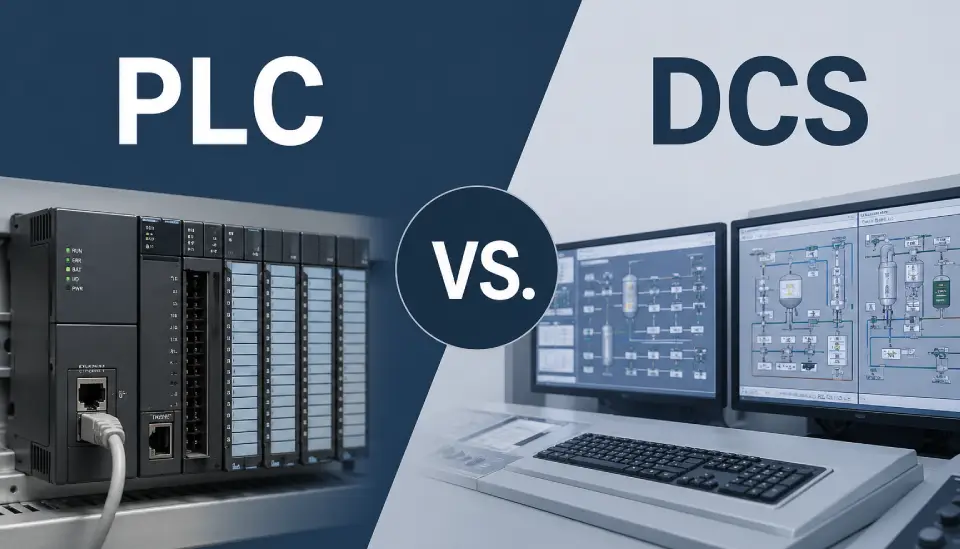
When evaluating control system architecture for an industrial project, one of the most consequential decisions you’ll face is choosing between a Programmable Logic Controller (PLC) and a Distributed Control System (DCS). Get it right, and your facility runs efficiently for decades. Get it wrong, and you’re looking at costly retrofits, operational bottlenecks, and scalability headaches that compound over time.
At Twilight Automation, we help industrial clients navigate exactly this decision every day. This guide breaks down the core differences, the factors that should drive your choice, and what each platform really costs — both upfront and over the life of your system.
What Is a PLC?
A Programmable Logic Controller is a ruggedized digital computer designed to automate discrete electromechanical processes. PLCs excel at binary, event-driven logic — think conveyor belts, packaging lines, assembly stations, and machine tools where the system needs to respond to discrete on/off signals quickly and reliably.
PLCs were born on the factory floor in the late 1960s as a direct replacement for relay logic panels. That heritage shows in their DNA: they’re fast, deterministic, compact, and built to survive harsh industrial environments. A single PLC or a tightly networked cluster of PLCs can handle tens of thousands of I/O points, and modern units communicate over industrial Ethernet protocols like EtherNet/IP, PROFINET, and Modbus TCP.
Typical PLC applications include:
- Automotive assembly lines
- Material handling and conveyor systems
- Packaging and labeling machinery
- CNC machine control
- Building automation and HVAC
- Water and wastewater pump stations
What Is a DCS?
A Distributed Control System is a plant-wide control architecture designed around continuous process management. Rather than a centralized CPU, a DCS distributes processing power across multiple controllers — each managing a defined process segment — with all nodes coordinated through a redundant, high-reliability communication backbone.
DCS platforms were developed in the 1970s for industries where continuous analog variables (temperature, pressure, flow, level) need to be maintained within tight tolerances around the clock. The emphasis is on system-wide coordination, seamless redundancy, and deep historian and alarm management capabilities baked into the architecture from day one.
Typical DCS applications include:
- Oil and gas refining and petrochemical processing
- Pharmaceutical manufacturing (batch and continuous)
- Pulp and paper mills
- Chemical plants
- Power generation facilities
- Food and beverage processing at scale
Key Differences: PLC vs. DCS Side by Side
Understanding where these platforms diverge is the foundation of a smart selection decision.
Control Philosophy
PLCs are built around scan-cycle logic — executing ladder or structured text programs in discrete, rapid cycles. DCS platforms are built around continuous loop control, with PID tuning, cascade control, and process modeling deeply integrated into the engineering environment.
Scalability
A PLC system can scale through networking and remote I/O, but the engineering effort grows proportionally. Adding a new process segment typically means new programming, new integration work, and careful testing. A DCS is architected to scale horizontally by design — adding a new controller node to an existing DCS backbone is far less disruptive to the overall system.
Redundancy
Redundancy in a PLC system is achievable but must be deliberately engineered — redundant CPUs, redundant power supplies, and redundant communication paths are add-ons. In a DCS, redundancy is standard architecture. Controller pairs, redundant I/O buses, and hot-standby failover are built-in expectations, which is why DCS dominates in high-availability, continuous-process environments where an unplanned shutdown costs hundreds of thousands of dollars per hour.
Operator Interface and Historian
PLC systems rely on separately sourced SCADA software (Ignition, FactoryTalk, WinCC, etc.) for HMI, trending, and data logging. A DCS includes an integrated operator workstation environment, alarm management, and process historian as part of the platform — reducing integration complexity but also reducing flexibility.
Engineering Environment
PLC programming environments (Studio 5000, TIA Portal, Codesys) are vendor-specific but relatively accessible. DCS configuration platforms tend to be more complex, require specialized training, and are more firmly tied to a single vendor’s ecosystem. This is a real long-term consideration for maintenance staffing.
Cost Considerations
Initial cost often favors PLCs. For a standalone machine or a small-to-medium process cell, a PLC-based solution can be significantly less expensive to specify, commission, and integrate. DCS platforms carry higher licensing costs, require more specialized engineering hours, and demand a larger upfront investment in infrastructure.
Total cost of ownership tells a different story for large, complex operations. A DCS designed for a 10,000-point continuous process plant will be less expensive over 15–20 years than attempting to build equivalent functionality with a sprawling PLC network. The integrated historian, alarm management, and redundancy of a DCS reduce long-term maintenance burden, minimize unplanned downtime, and lower the per-point integration cost at scale.
The crossover point varies by project, but a useful rule of thumb: below approximately 2,000–5,000 I/O points in a discrete or mixed environment, PLCs typically win on economics. Above that threshold in a continuous process environment, DCS becomes increasingly cost-competitive — and often the lower-risk choice.
Industry-Specific Guidance
Manufacturing and Discrete Industries: PLCs are the standard for a reason. The speed, flexibility, and broad ecosystem of PLC platforms make them the right tool for assembly, packaging, material handling, and machine automation. A well-architected PLC network with a modern SCADA layer can meet virtually any requirement in this space.
Oil, Gas, and Petrochemical: DCS dominates here, particularly in refining and upstream processing. The continuous nature of the process, the regulatory requirements for alarm management (ISA-18.2), and the catastrophic cost of unplanned downtime all favor DCS architecture. Safety instrumented systems (SIS) run alongside but separate from the DCS.
Pharmaceutical and Biotech: Both platforms appear here, often together. Batch manufacturing may use a PLC-based solution with ISA-88 batch management software, while continuous bioprocessing increasingly favors DCS. FDA 21 CFR Part 11 compliance requirements for electronic records and audit trails are well-supported by modern DCS platforms.
Water and Wastewater: Predominantly PLC and SCADA. The geographically distributed nature of water infrastructure, the relatively lower I/O density per site, and the need for remote access over wide-area networks make PLC-plus-SCADA the dominant architecture. DCS appears in large treatment plants with significant continuous process complexity.
Power Generation: Both platforms are used, often together. Plant-level DCS manages the continuous generation process; PLC-based systems handle balance-of-plant equipment, auxiliary systems, and discrete machinery.
The Real Question: What Does Your Process Demand?
The PLC vs. DCS decision ultimately comes down to three questions:
- Is your process primarily discrete/event-driven or continuous/analog-intensive?
- What level of built-in redundancy and availability does your operation require?
- What is the realistic 10–20 year lifecycle cost, not just the capital cost?
Neither platform is universally superior. The wrong answer isn’t choosing PLCs or choosing DCS — it’s choosing based on budget alone, or defaulting to what’s familiar without analyzing what the process actually demands.
Work With a Control System Partner Who Knows Both
At Twilight Automation, we’re platform-agnostic. Our team has hands-on experience designing, commissioning, and optimizing both PLC-based and DCS architectures across manufacturing, process, and infrastructure industries. We bring that experience to bear before you’re locked into a specification — so your control system fits your process, your team, and your budget for the long haul.
Ready to talk through your application? Contact Twilight Automation for a no-obligation consultation with an automation engineer who will ask the right questions before recommending an answer.
Twilight Automation provides industrial control system design, integration, and support services. Based in the Midwest, we serve clients across manufacturing, process, and infrastructure industries.